Archive for October, 2009

The Differences Between Countries Can Cost You

Oct. 30th 2009

Do you run your PPC ads in different countries? If so, do you change your ad copy and landing page copy when targeting those different markets?

For many years, global brands have altered their marketing campaigns to target different countries.

An advertisement for a food product running in Australia may be markedly different from an advertisement for the same food product in the USA.

Why?

Whilst we share a common language, cultural values and norms differ markedly from country to country, and even region to region.

For example, what is considered soft sell in the US is often considered hard sell in the UK due to differing acceptance of overt commercial activity in those two cultures.

There are many differences:

Viewed from commercial America, British advertising looks like something bent out of shape by a culture so consumed with embarrassment it can’t look a salesman in the eye when he’s making a pitch, particularly if that pitch is laden shoulder high with emotion – love of country, family or God. From a mainstream US perspective our quirky elliptical leave-them-guessing advertising approach is kind of charming, but kind of unworkable too in America, with its fragmented audiences and ethnicities, its raging sensitivities and, above all, its huge risks. American advertising is risk averse because there’s so much at stake with those huge clients and their mega-spends. It means everything is researched to death so all backs are covered.

If you’re running a PPC campaign in different geographic markets, then you’re running a global campaign. So, you need to think about approaching such a campaign as a global brand would do, and tailor your message accordingly.

Your competition – who may understand those local markets intimately, as they live and work in them – will be designing their pitch based on local norms, so too should you, if you want to convert.

Here are a few ideas on how to target different cultures effectively:

1. Watch What Others Do

Take a look at how your product or service is advertised in other media in your target country. What language do they use? What imagery do they use? How are they making the pitch? Is it subtle? Hard sell? Humorous?

Now evaluate the ad copy and landing pages of your PPC competitors. What similarities do they share to each other? To ads in other media? How do they differ from how you would advertise in your own local market?

2. Spelling

A PPC ad written using US spelling displayed in another country screams “not relevant to this market”, especially when surrounded by ads that use local spellings.

Use “s” instead of “z”, and watch those vowels! :) Color becomes colour, center becomes centre and check becomes cheque.

Here’s a good reference guide to common differences.

3. No, They Don’t Think “Because It’s American, It’s Great”

Every culture thinks what they do is great, and what foreigners do is suspect.

Just as you don’t assume that something from Germany is great, Germans aren’t going to assume that something from America must be great. Some may even be hostile to the US – it just comes with the territory of being the new Roman Empire :)

It’s not that you have to cave to others demands, but it does pay to be aware of them. If you’re trying to convince someone to buy something, then you need to talk the customers language, on their terms, no matter if they live in New York or, well, York.

4. There Are Regional Differences

Just to complicate matters, there are significant differences between language in different regions in many countries, and particularly in the UK.

Just like there are differences between New Yorkers and Angelenos, there are differences between those in the north of England, and those in the South.

The South tend to think of themselves as intellectually and culturally superior to Northerners, and Northerners tend to think of Southerners as soft, fake and, well, elitist. These are generalisations, of course, but be aware that they exist, as these differences may alter your pitch.

5. Test

As always, test.

Change the language of your landing pages and ads depending on the accepted norms of local markets. Align your language and style with the most successful PPC ads targeting those markets.

Run with the winners and cut the losers.

Final Thoughts

The world is get smaller. The internet, and tech in general, is being driven from America. Naturally, it comes bundled with US cultural values.

This is leading to the Americanization of other countries and making boundaries, both physical and cultural, less of a block than they have been previously.

A pitch that works in America can translate into other cultures without change, but that won’t happen as a matter of course.

Think local.
Posted by Giovanna | in Geo Targeting, Landing Pages | 1 Comment »

Google’s Display Ad Strategy

Oct. 19th 2009

AdAge highlighted Google’s Campaign Monitor, a display ad measurement tool which has been in beta for the last year:

With Campaign Insights, Google takes data from the advertiser’s server logs to determine who was shown an ad and when. Then compares that to web searches and site visits culled from data from the millions of Google toolbars on computer desktops. Those results are compared to a comparable group that didn’t see the ad.

Then Google measures the difference between the number of brand searches and site visits between the two groups. To filter out the impact of other media or influences, such as a TV campaign, Google compares the data to the two groups’ behavior before the campaign began. The incremental difference is attributable to the display-ad campaign.

So you have to give Google your server logs, and in return you get Google massaged data. Yet another form of market transparency through opacity.

Off the start I am sure it will be fairly accurate, but 3 years from now when…

  • the market is more mature
  • Google introduces quality scores and other such levers
  • Google is trying hard to hit the quarterly numbers

…I am not sure how much it would make sense to trust Google for these kinds of measurements. Of course opinion won’t matter if Google is the only game in town. It would benefit Microsoft and Yahoo! to push hard on this front because whoever gets the data partnerships locked up first will end up with a more efficient market and higher yields…eating market-share from other ad networks.

If they are honest with the data it might be a bit of an up hill fight. Even within the search channel the idea of attribution is iffy. Andrew Goodman wrote:

Problem: 74% of purchases can only be attributed to a single click anyway. By definition, that’s the last click. Attempt to “attribute” that purchase to prior clicks or other factors? Good luck.

So the next revelation: when you bucket keyword queries down into distinct types, only 7% of sales can attribute significant influence to some kind of click other than the last click.

And large advertisers, growing more aware of that lack of search buying funnel, are starting to spend more on longtail search keywords while avoiding bidding wars on top keywords, as reported in the WSJ:

Sprint is buying the top ads tied to phrases consumers tend to search for when they are close to making a purchase, such as “cellphone rate plans” and specific products like “Samsung Reclaim,” rather than more generic phrases they search for at the beginning of the shopping process, like “Sprint,” “AT&T” and “cellphone.” Pricing for the more-generic terms tends to be higher, yet less for important to driving sales, Mr. McPhillips says.

Of course if lots of big advertisers follow the same strategies they may leave holes in some markets. In a recent interview, researcher Jim Jansen claimed just the opposite…that the broad keywords were cheaper and provided more bang for the buck:

In terms of classifying queries in terms of what advertisers’ payoff is, I think the most interesting finding was that the purchase queries, the last stage of the buying funnel, were the most expensive and had no higher payoff than the awareness or the very broad, relatively cheaper queries. From talking to practitioners, that is a phenomena that they have noted also… which is why a lot of people bid still on very broad terms, to snatch these potential customers at an early stage.

My  SEO experience and PPC experience has been more inline with seeing great ROI on the longtail keywords. But with SEO for some really long-tail cases the page can be set up to pull in traffic that is so niched that it becomes harder to find relevant advertisements and offers to match up against the traffic stream. And of course the issue with longtail PPC is getting much volume.

Posted by Giovanna | in Display Ads | 1 Comment »

What if Yahoo! Search Marketing Was Smart?

Oct. 13th 2009

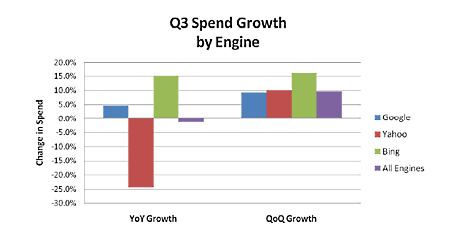
I was reading Twitter today and saw Yahoo! Ads Buzz share a link to a Search Engine Watch blog post highlighting trends in paid search. Both Bing and Google keep growing year on year, whereas Yahoo! Search Marketing has just been decimated.

The shocking thing is that Yahoo! would even want to share a link that showed how badly they are losing marketshare in the paid search market. Or that they would be able to see the stats and not understand what is causing the issue, in spite of people spelling it out publicly and thousands of advertisers complaining about it.

As my buddy Sean Turner described via chat…

To break it down, yahoo gives you a feed for seobook.com & you give me a feed for turner.com. But all links that are clicked on turner.com redirect through seobook.com so that it shows up in customer logs as seobook.com If you block seobook.com, it will block ads from seobook.com, but not turner.com. The blocked domain tool works on what domains display, not on where the feed is redirected through. So if you are a customer, there is no way to know that turner.com is sending traffic (since it’s redirecting through seobook.com) and no way to block it through seobook.com since that tool only works on the domain that is actually displaying it.

I found it because we kept getting traffic from gogogo.com. We had blocked it over and over and couldn’t figure out why they kept sending us traffic. We couldn’t find our ad on their site. I went to live.com and ran a site:gogogo.com search and found that it indexed some of those landing pages that use gogogo.com as a monetization service.

Yahoo!’s lone bright spot in the search market is their BOSS service. And now they are letting BOSS syndication partners monetize with Yahoo! ads, but they are being stupid about it – forcing you to go through a 3rd party partner so they have no way to clean the good from the bad.

Economic incentives are pretty easy to understand. Let people mix in junk with good stuff and they will keep watering it down.

There is an endless supply of fraud willing to take free money.

You only need to look at this 1 chart to see how bundling syndication and scams with search causes fraudulent activity. Advertisers are not stupid (especially during recessions). Which is why they have opted to shift ad dollars away from Yahoo! toward the other search engines.

Update: It looks like as part of a class action lawsuit Yahoo! is required to create an ad distribution channel that allows option out of many of the syndication types:

“Premium Providers” means: (a) all web sites and web pages (including any microsite), software applications and other properties on the Internet that are owned or operated by Yahoo!; and, at Yahoo!’s option, (b) all parts of the Distribution Network other than: (i) domain name parking sites; (ii) bulk registration sites; (iii) “pop-up” or “pop-under” windows; (iv) typosquatting sites; (v) “sliders”; (vi) “sidebars”; (vii) “injected ads”; or (viii) unsolicited spam email.

And in spite of that they still are running BOSS syndication through a 3rd party partner.

Posted by Giovanna | in Yahoo | 2 Comments »

Google AdWords Testing New Flat Rate Local AdWords Ad Pricing Model

Oct. 9th 2009

Local businesses tend to be easy to service (because of limited competition), but tend to be hard to service profitably (due to big demands and small budgets).

Such companies are still spending billions of dollars advertising in yellow page directories across the United States because it is easy and flat rate. Search advertising makes advertising more granular and trackable, but most small businesses could not be bothered with it. While the dead tree advertising model is in decline

Only the local interactive segment will show growth throughout the forecast period. All other local media will experience marginal to rapid declines in the next 18 to 36 months. A small number of traditional media will rebound with a revived economy beginning in 2011, though most traditional media will continue to decline, albeit at a slower pace.

…Google is looking to help transition small local business advertisers over to search by employing familiar flat rate advertising services, as highlighted in AdAge:

In a bid to get more local advertisers to buy search ads, starting this week Google is trying out a new type of search ad and pricing system in the San Francisco and San Diego markets.

Rather than ask businesses to set up a campaign and bid for keywords, they’re offering local advertisers (or non-advertisers) a search ad for a flat fee. The fee is set by Google and based on the average that similar businesses are paying for a given keyword in that market.

Lets go ahead and take one more look at that last sentence

The fee is set by Google and based on the average that similar businesses are paying for a given keyword in that market.

So Google is using your keywords and your bid prices to automate setting up accounts for competing businesses. You pay them for traffic and they arbitrage your efforts by using you as a free market research tool for competing businesses. And imagine if/when Google has 5 companies in your market all bidding based on the same flat fee average strategy. Some keyword prices could fluctuate wildly as the house decides to arbitrarily bid up or down a particular keyword or basket of related keywords.

In an earlier piece Mona Elesseily mentioned a recent Nick Fox keynote where he mentioned the idea of keyword-less paid search accounts, and how Google could run them:

Nick mentioned that keywords were used as a proxy for relevance. Conceptually, there is no reason an advertiser couldn’t achieve the same results without having to directly manage a keyword list. Down the road, Google wants to state outcomes and have machine-based learning and algorithms come up with the best method of achieving specific outcomes. In the case of no keyword search, an advertiser (like a retailer) would provide information on products, product descriptions, pricing, etc. and Google would use the information to find the most effective way to place ads in front of potential customers.

Those machine-based learning algorithms need input to become efficient. What happens if you share your conversion data with Google? This is one of the areas of opportunity on the web for 3rd party analytics providers. As Google continues to make advertising easier (and seemingly cheaper – at least up front) there will be added value in operating outside of their ecosystem and/or limiting how much data you hand over to the borg.

Presumably as this gets easier to automate and test it will increase the value of related services like website design and conversion testing (until those are automated and commoditized as well). But some smart business owners who enter the search game via these automated technologies will likely eventually want more granular control of their strategy, as it is hard to build a long lasting sustainable business based on market averages – especially when the fox is guarding the hen house. Over time those who evolve their model to increase lifetime customer value, increase conversion rates, and build distribution outside of search will eventually make the average price too expensive for an average business to be able to afford advertising.

Depending on how successful this test is, there are all kinds of implications for advertisers like…

  • building and maintaining sustainable profit margins in an environment where machine learning algorithms see your max bids and work against you with every search and click
  • deciding how much data to share with Google
  • deciding if it makes sense to mix together multiple regions on 1 site to make it harder for search engines to use your campaign as a seed for competitors
  • deciding if new business lines (and perhaps some longtail keywords) should be bid on for different websites that are not bidding on keywords associated with the obvious core industry keywords

And the general theme for online service providers is that if you are not thickening out your service prepared to be commoditized. Google does not need to create more value than you can, they only need to make businesses believe that you don’t add enough value to justify the additional expense, and that it is just easier for them to go with Google. Time to invest in brand building! Sometimes the SEO and PPC markets seem like mirror images. ;)

Decifering Google’s Quality Score

Oct. 8th 2009

New To Google Adwords? One aspect that will likely have you pulling your hair out is Google’s “quality score”.

Google’s quality score is a cryptic formula Google uses to help determine your keyword bid. The quality score affects your cost per click, eligibility to appear under a keyword term, estimates the cost of appearing on the first page of results, and affects how high your keyword is ranked.

Generally speaking, if your quality score is higher than that of your competitors, then you will be paying lower PPC prices.

How Can You Improve Your Quality Score?

Google, being Google, don’t spell it out. That would be too easy :)

Instead, they provide general guidelines to follow.

In summary, Google suggest that in order to improve your quality score, you need to maintain high click-thru rates, your account history needs to have high click thru rates, the click-thru rate to a specific URL needs to be high over time, and the keywords in the ad group must be relevant. They also mention “other relevance factors”, which could mean anything.

How Do I Find Out A Keywords Quality Score?

Each keyword term has a quality score. Google will list the quality score as being “Great”, “OK” or “Poor”.

Obviously, you want to have a “Great” quality score, and not an “ok” or “poor one”. So what seperates the three?

The most significant factors are relevance of your ads, your click-thru rate – especially your recent click-thru rate – and your account quality score. “Account quality” refers to the sum total of all the keyword quality scores within your account.

So, in order to achieve a “great” score, focus ruthlessly on raising your CTR, and don’t leave a lot of low quality keywords active in your account.

What Do I Do If My Minimum Bid Price Is Still Too High?

If your minimum bid is too high, take a close look at your landing page. Do you feature the same, or similar related keywords, on your landing page as featured in your ad?

Google’s landing page guidelines are here.

Besides relevance, make sure your page is original and contains substantial content. Avoid the “affiliate trap” of using pages solely as a means to direct people to a parent site. Finally, check basics, like ensuring the user can click back, don’t use pop-ups and avoid slow page load times.

Does Page Rank Affect My Quality Score?

Strange as it may seem, and even though Google denies it, many claim the the authority of the domain hosting the landing page does affect the quality score.

While there is a lot of debate about this aspect, placing your landing page on a reputable domain certainly can’t hurt and may well help, so if you do have the option place your landing page on a quality domain. Link to that landing page internally. Link out to reputable resources from your landing page.

Did Eric Schmidt let something slip when he said Google may use brands to clean up the internet cesspool? Could this also apply to Adwords?:

According to Google CEO Eric Schmidt, the Internet is a “cesspool” where false information thrives…..Schmidt gave the magazine publishers hope for their future. Brands, he said, are the way to rise above the cesspool, and of course he is right.

Do we know for sure? No, we don’t. We’ve seen anecdotal evidence suggesting that the credibility of the domain can affect the quality score, although it may just be a side effect of Google trying to weed out thin affiliates.

Try testing a landing page on a new domain vs an established credible domain, and see if you notice any difference in terms of your quality scores and bid prices. Have you noticed a difference to your quality scores if you place the landing page on a reputable domain vs a new domain, or a domain that doesn’t appear in Google’s index?

Do you have strong views either way? Let’s here ‘em in the comments!

Be Careful Moving Keywords

We all need to optimize our campaigns, and doing so is a great way to ensure a higher quality score.

One thing you need to be careful of is moving keywords. Because keywords have a history, take special care not to delete them. Instead, use the Adwords Editor to cut keywords, lest you delete their quality history. See Google’s detailed instructions on moving keywords.

Posted by PeterD | in Marketing | 1 Comment »