Archive for September, 2008

Why You Must Test & Change Your PPC Bid Strategy

5 Comments Written on September 29th, 2008 by
Categories: PPC Tools

Years ago some noted PPC experts like Perry Marshall recommended bottom fishing AdWords for deals in some competitive markets, claiming that as searchers moved down the listings they were more pre-qualified to make a purchase.

Google’s ad quality score algorithms, bid prices, editorial standards, and the competitive landscape of paid search have changed to where it is much harder to find deals with nickel and dime clicks. Google favors smaller tight lists of keywords over broad mix and match ad groups. And, in an attempt to kill off many forms of ad arbitrage, they made a decision to recycle leading ads against the long tail vs letting longtail advertisers get those clicks for cheap.

27 minutes into this video Dan Thies claims that their sales per click dropped off as their ads moved down the page.

Today George Michie published a blog entry on Search Engine Land about why position bidding wastes money, claiming that the value of traffic doesn’t vary by position (though stating it does vary by time of day and day of week).

The next time someone tries to engage you in a discussion about “finding the right position” for a particular term, remind them that the value of the traffic is measurable; but the cost of a position is unknown, and unknowable, changing based on the whims of your competition. Bottom line: don’t let your competitors run your search program.

Mr. Michie linked to a PDF titled An Empirical Study of Search Engine Advertising Effectiveness – though that statistical study focused on one advertiser in the automotive group. None of these citations should give you a clear optimal bid position strategy, but all should give you encouragement to test your market and find out what works best for you.
Is Display Advertising Getting the Shaft?

3 Comments Written on September 20th, 2008 by
Categories: Contextual Advertising, Microsoft Adcenter

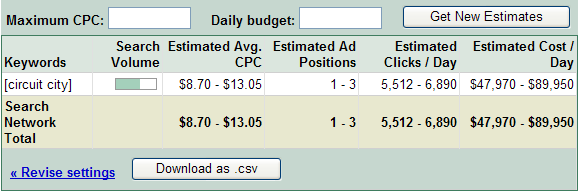
Should Circuit City bid on their own brand? How much does Google estimate that daily cost at?

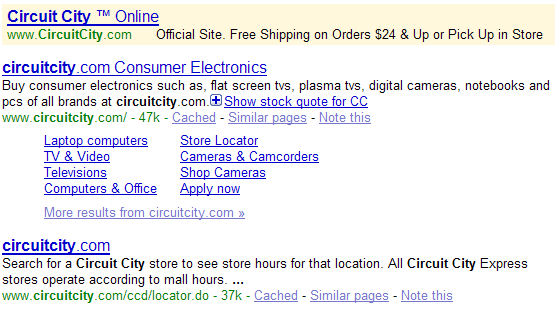
That estimate may be high, but even if it is off by a factor of 10 Circuit City would be spending a quarter million dollars a month on brand equity they already built up! Given the amount of organic exposure CircuitCity.com currently enjoys for that specific query they should be able to get their ad messaging in the organic search results without paying Google.

Exclusively focusing on ROI has advertisers bidding on their own brands and giving Google a large sum of money for the brand equity and user demand that the brand has already established. But they should be able to get that ROI without paying Google a cent. If the above area in the organic search results is not enough space for Circuit City’s brand related search ad strategy, they could always use subdomains and/or launch CircuitCity.org or CircuitCity.net.

Look at how some of the web only retail and marketplace comanies like Amazon.com, Yahoo! Shopping, and eBay dominate brand searches on Google through the use of subdomains. Buying brand related searches is only a must if

  • your brand is generic (Shopping.com, Credit Cards.com, PPC Blog, SEO Book, etc.)
  • you let your affiliates bid on your brand related phrases
  • Google puts competing ads above the fold for your brand

Google has long pushed the value of tracking the direct ROI of ads as a way of driving their AdWords search ad marketplace, while simultaneously giving advertisers a good deal on content ads (by lowering the perceived value of content ads).

The Wall Street Journal published Rallying Cry for Display Ads, an article which makes the case that the value of display advertising is not being adequately measured and search is getting too much credit. The article promises that next week Microsoft will offer evidence “that it says proves display ads are actually better than searches at triggering consumers.”

The major conclusion of this research: By the time consumers search for a product or service, they’ve often already made up their minds to buy it. And display ads are often an important factor in their reaching that conclusion.

Even if the research is true, will Microsoft be able to use it to persuade advertisers to spend more on content ads that they have become accustomed to getting for next to nothing?