Archive for September, 2009
Banned From AdWords? How to Improve Landing Page Quality Scores
Over this last weekend, some Adwords users have received a warning email from Google stating that their landing pages are of poor quality and do not comply with Google’s landing page and site quality guidelines.
Some users have already been banned outright.
Here’s an automated response from one user who queried the ban:
As the email you received on Friday explained, your account has been suspended due to multiple submissions of poor quality landing pages. We are unable to revoke your account suspension, and we will not accept advertisements from you in the future
Check out the discussions at Webmasterworld and the Google AdWords Forum. Has there been a change in quality standards? A new rule? Perhaps a harder enforcement of a previously lax guideline?
Naturally, webmasters are irate. There appears to be no official comment from Google, but we’ll keep you posted.
In the meantime, let’s take a look at Google landing page quality standards.
Adwords Landing Page Guidelines
Google introduced a quality score back in 2005. This quality score covered various data points, including the ad text and click through rates, and helps ensure the user finds what they’re look for.
Soon after, Google added a landing page score to the mix.
This score evaluated the landing page in terms of relevance i.e. the page should reflect the promise made by the ad.
The text also must be original, so that users aren’t seeing the exact same landing page if they click on different ads. There should not be excessive pop-ups, or any means to “trap” the user i.e. disabling the back button.
In many ways, these policies mirror the type of sites Google ranks in the organic serps, relevancy to the keyword term being the primary requirement.
Here are Google’s official landing page standards.
Now, Google uses an automated bot to determine compliance, yet Google doesn’t provide a means for webmasters to test their pages, presumably because they want to keep their scoring mechanisms a secret.
How Can You Tell If Your Landing Page Is Optimized For Google’s Quality Standards?
Dave Davis has an excellent tutorial on SearchEngineJournal.
Check out W3 Semantic Extractor and the Google site related keyword tool. What better way to get information about what Google thinks your site is about then using a tool designed by Google to figure out exactly what your site is about?
In summary, you need to ensure your page contains the same or similar terms as appear in the Adwords ad, and these terms need to be displayed prominently on your landing page in order to comply in terms of relevance.
If you go one step further and test your pages using the site related keyword tool, and the semantic extractor, you stand a good chance of achieving a high quality score.
Google’s Tips to Improve Quality Score
Google, as usual, require you to read between the lines. Let’s examine some of their guidelines more closely:
Link to the page on your site that provides the most useful and accurate information about the product or service in your ad.
Ensure the landing page and the ad are identical in terms of subject matter. Click-backs can affect your quality score, so make sure you repeat the keyword term high up on the page, in bold, in your copy. This also helps reaffirm to the user that they’ve arrived at the right place.
If your site displays advertising, distinguish sponsored links from the rest of your site content
Your page can’t consist mostly of ads. I’ve seen a lot of pages getting away with this, however.
Try to provide information without requiring users to register. Or, provide a preview of what users will get by registering
Pretty obvious. Users typically don’t register for something unless they desperately want what you’re offering. There is a high likelihood they’ll click back if presented with registration as the only option.
In general, build pages that provide substantial and useful information to the end-user
That’s a big one. Google don’t want just an ad, and certainly not a misleading one. They want information, much the same as they require in the organic search results. Focus on providing user utility and you can’t go too far wrong.
If your landing page consists of mostly ads or general search results (such as a directory or catalog page), you should provide as much information as you can beyond what your ad describes. For example, if your ad mentions <’Free travel information,’ your landing page should feature free travel information (versus links to other sites that do).
Your page should be an informative destination in itself. Of course, you need to balance the commercial imperative – making a conversion – with an informational one.
You should have unique content (should not be similar or nearly identical in appearance to another site). For more information, see our affiliate guidelines.
As mentioned, earlier, Google will want to avoid showing the same page to users if they happen to click multiple ads. It’s not hard for Google to spot duplicate content, so make sure your text is original.
Increase value & customer satisfaciton through using different strategies. To avoid duplication, consider various angles. i.e. instead of talking about the product itself, provide a “how to solve a problem” page for users. This how-to, of course, will recommend the product in question. Tell a story about using the product, provide unique testimonials, etc. Avoid cutting and pasting from the suppliers website.
What Service?
Finally, a lot of the emails concerning the banning appear to have been sent to affiliates, both direct-to merchant and otherwise. There are some big spenders in there, so it looks like Google is tightening the noose on the middle man, once again.
It’s easy to understand the frustration, given the vagueness, and neatly summed up by a WebmasterWorld poster:
You buy a laptop for $1K from HP,DELL, or IBM. This laptop has much lower margins than sending a few bytes over the wire. Yet, if you have a problem you expect, and you will be able, to contact someone in support via toll-free phone, live chat or email to resolve the problem. If the result is not satisfactory, you can get the problem escalated to a case manager or eventually executive support. At some point someone with sufficient *authority* to fix your particular problem will respond.
But, if you spend $100K on ads, the best you can get is a vague automated email.
Heh. Makes you wonder what some of these pages look like? Anyone got an example of a banned page they care to share?
Online Ad Exchanges – Watering Down the Water
How do ad networks that nobody has ever heard of create enough inventory to pull in premium advertisers? It’s simple: create it!
A recent MediaPost article was titled Half Of Ad Impressions, 95 Percent Of Clicks Fraudulent. From that article:
Many of the sites in these exchanges use multiple layers of I-frames, which further complicated efforts to track campaigns. Sites are able to hide fraudulent traffic behind numerous layers of nested I-frames, leaving advertisers blind to in-view data, according to the study.
Mpire believes the default trafficking behavior of many RON buys is to include fraudulent and well-known botted sites. Gluck writes in the study that not all marketplace or exchange traffic is bad, but rather simply includes nefarious inventory that ad networks could block, but for some reason do not.
If you are a legitimate advertiser using these networks, they are stealing your money. If you are a legitimate publisher your inventory is being priced down because it is being priced against, compared against, and often sold in a bundled package with pure fraud. Even if you choose not to sell ads in the ad exchanges, your media is still being compared against the garbage, and the garbage is driving down the perceived value of your inventory. Thus many of these ad exchanges are a perfect mixture of the tragedy of the commons and a market for lemons.
A few years ago I remember listening to a sleazy affiliate marketer talking about how mixing your traffic in with other traffic was a benefit. No wonder, as guys like him were working the iframes + pushing cookies + using bots to view pages and click ads and fill out lead generation forms. He was operating at a criminal level, stealing from whoever he could, but had yet to go to jail.
Every network that collects leads has buckets of different quality levels. SEO and search PPC tend to be toward the top, as search is pure as the snow. And then the volume guys tend to fill up quota with trash. On average the quality is good enough to keep selling it, but the premium quality stuff is being discounted by the people who are mixing junk into the equation.
In the comments section of the above MediaPost article Sylvie Chen added
When we designed a Behavioral Targeting Ad system, it was quite obvious that RON Ad networks always exhibited a higher click thru rate but very low click to buy rates. Our suspicion was that these sites had some mechanism that ’simulated actions’. When we analyzed the IP addresses, the first node was always the same, clue to either bot controlled or site controlled robot clicks.
These simulated interactions make it seem like there is some value (chalk it up to brand, or some such), but unfortunately if a bot clicks your ad that does nothing for branding
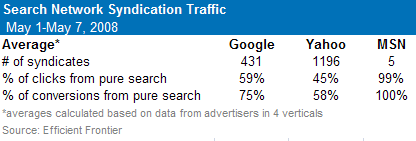
How big of a hit are some publishers taking from this fraud? Well Yahoo! didn’t allow advertisers to opt out of their content network when buying search traffic, and consequently some of their search traffic was priced at only ~ 1/3 of what the same click would cost from Google. It is no wonder Yahoo! had to sell off their search assets when they were being out-monetized 3:1 on core keywords (due in part to fraudulent traffic partners). And the cost to non-search publishers in these ad exchanges is likely even greater than it was to Yahoo!, since there is so much more watered down inventory (relative to legitimate inventory) in such ad exchanges. At its worse, about half of Yahoo!’ Searches ad clicks came from search, whereas some of these ad exchanges have their legitimate inventory measured in the single digits!
This leads back to why the price of a search click is often higher than what some affiliate networks or advertisers pay for leads: because the search traffic is real & targeted, unlike a lot of robotic and incentivised traffic sources. Search converts higher, and often has a higher average conversion value.

Plus who has time to sort through thousands of fake leads each month? They not only offer no value, but they also waste time that could be spent further qualifying and servicing the legitimate leads!
Want to read the Mpire’s full report? Download it hear.
Google Bid Simulator
Google have announced a new Adwords feature called Bid Simulator.
From the Google Adwords blog:
Bid Simulator takes some of the guess work out of cost per click (CPC) bidding by estimating the number of clicks or impressions you could have received if you had used a different maximum CPC bid.
Google have also provided a tutorial video showing you how to work out your value per click, and how to use this value to maximize your profits.
This video provides a great overview of the economics of PPC bidding, then goes onto show you how to use the Bid Simulator tool to arrive at the most profitable bid.
In summary:
- Determine your max profitable CPA
- Determine your conversion rate
- Calculate your value per click
- Adjust your bids so value per click = ICC (Inceremental Cost Per Click)
This tool, whilst useful in terms of taking a lot of trial and error out of bid setting, will provide marginal benefit in areas where the keyword auction is fierce. If the auction is busy above you, then you’re still going to need to raise you bid a lot for minor increases in volume.
Indeed, some of the recommended bid prices seem very high. The danger is that some people may see this as a helpful autopilot, when really it’s just another “suggestion” tool. Be wary.
The tool is possibly most useful when there is moderate activity in the bid range. Andrew Goodman suggests that Bid Simulator might help a lot in terms of saving cash on the low side:
Case by case, it gets interesting. Take, for example, an account where you figure you’ve done a great job whittling average CPC’s down to 23 cents. Now on a lot of the keywords that you’re getting for 15 cents, you’re not doing great ROI-wise, but you’re reasonably content since the price is low by historic and industry standards, you don’t feel like risking the effort to go down to 11 cents. I think the bid simulator may be helpful in helping advertisers decide when to take risks like that. Shaving those few pennies on lukewarm keywords, across several hundred keywords and a thousand clicks a day, can add up to a lot of saved cash you can then turn around and devote to better performing keywords or channels (or simply, profitability).
Also, as it is a simulator, your actual mileage out on the real Google may vary.
Here’s a presentation on how to use the bid simulator within your Adwords account.
PPC vs SEO
Search marketing consists of two channels: PPC (pay-per-click) and SEO (search engine optimization). Both channels have advantages and disadavatages you need to consider before committing resources to either approach.
Advantages Of Google AdWords Over SEO
Minimal Impact – Most sites won’t need to make design or layout changes in order to use PPC. SEO often requires site design changes, and these changes can be significant.
Instant – Traffic can start flowing in a matter of minutes once a campaign has been launched. With SEO, traffic can take some time to build, and there is no guarantee it will arrive at all.
Pay On Performance- You only pay when you receive traffic. If you do not receive traffic, you owe nothing. SEO requires a large upfront investment with no guarantees of campaign performance. Traffic and visibility isn’t directly controlled by the SEO.
Precise Keyword Targeting - You chose the keyword terms under which you appear. This allows you to run tightly focused campaigns. With SEO, pages can appear under a wide range of keyword terms, and sometimes these terms are unrelated to your campaign. This can make campaigns difficult to measure.
Precise Tracking And Adjustment – You get instant, precise figures, and you can adjust your campaigns in real time. SEO campaigns can be adjusted, but it is time consuming, and the results of which might not be seen for months.
Landing Page Control – You decide which page search visitors see. With SEO, visitors can arrive on any page the search engine has in its index.
Region Control – You control the regions and countries in which people see the ads. With SEO, you have no control over regions or countries.
Buy Position – want to rank #1? You can pretty much buy it with PPC. SEO is hit and miss affair when it comes to ranking, and ranking for highly competitive keywords can be virtually impossible for new sites.
Control Your Budget – You can specify how much you want to pay for any given period, and you can stop and re-start campaigns when it suits you. SEO is largely an upfront cost, and the campaign can’t easliy be switched off.
Time Control - You can control when your ads are seen. SEO has no such control.
Advantages Of SEO
Given the features and flexibility of PPC, why would people use SEO?
It comes down to two things:
cost per click and trust
SEO has zero cost per click. Of course, this doesn’t mean SEO is free. SEO is time intensive, and time costs money. It can also involve third party costs, such as link buying. However, the on-going cost of a well executed SEO campaign can come in well under that of PPC, especially if good rankings are maintained.
People tend to trust the main listings more so than they trust the paid listings. The main listings receive the lionshare of attention and clicks.
In the study “An Empirical Study Of Paid Listings In Product Search And Purchase” (PDF) the researchers found users to be suspicious of paid results:
For paid listings to yield the financial results that are
anticipated by the business community, it is critical that
consumers perceive paid listings and their descriptions
as relevant to their transactional tasks. The results of this
study support previous findings that this may not be the
case, but also provide some guidance for the
development of paid listings. Participants in the study
showed a bias against paid listings in several ways. They
reported an explicit suspicion about paid listings in their
verbal protocols. They rated the relevance of the paid
listings as lower than the organic listings despite the
content of the descriptions being controlled across listing
type
However, it should be noted that eye pattern studies show both high positioned PPC and organic listings achieve significantly more attention than lower ranking listings, organic or otherwise.
The key location on Google for visibility as determined by the eye activity in the study is a triangle that extends from the top of the results over to the top of the first result, then down to a point on the left side at the bottom of the “above the fold” visible results. This key area was looked at by 100 percent of the participants. In the study, this was referred to as the “Golden Triangle”. Generally, this area appears to include top sponsored, top organic results and Google’s alternative results, including shopping, news or local suggestions.
The Advantages Of Feeding PPC Into SEO, And Vice Versa
Some of the most powerful SEO strategies blend PPC and SEO, taking advanatge of both systems.
PPC is an ideal testing ground for SEO. Typically, the SEO guesses if a keyword term is worth the time and effort of attempting to rank for that term. Perhaps the keyword term doesn’t receive as much traffic as the estimated numbers suggest. By running a PPC campaign on the keyword terms prior to implementing an SEO campaign, the SEO can get more accurate estimate of search volumes. The SEO can also test out the wording of language on landing pages to see how altering the copy to favor search spiders makes a difference to conversions.
Similarly, SEO can feed back into PPC campaigns. Because SEO casts a wide net, traffic logs can sometiems reveal lucrative keyword combinations that the research tools do not.
An SEO strategy, built up over time, should reduce the cost-per-click price of a combined strategy. If a site ranks well for expensive terms, then you may be able to switch PPC bidding away from these terms and use the funds on covering other terms.
Search Marketing: It’s All About Language
Search is all about language.
The keyword is a goldmine of information. Not only do you know how many people search on a keyword, the way the keyword term is used helps reveal to you the intent of the visitor. What order do people use words in the keyword phrase? What qualifiers do they use, or not use?
Once you figure out the visitors intent, you need to align everything you do with that intent.
Their Words, Not Yours
Many PPC advertisers make this basic mistake.
They focus most of their attention on the language of the PPC ad, and pay little attention to the language following the click.
Let me explain.
An advertiser carefully crafts a PPC ad. The advertiser includes the keyword in the title. The advertiser creates compelling ad text, aligned with the visitors need. The advertiser delights in the fact their ad appears above the competition, and that the ad is receiving a high number of clicks.
But they neglect to follow through the conversation established by the ad onto the landing page.
There’s More To Conversion Than Call To Action
If you’re not converting to desired action on the landing page, there can be a number of reasons. The offer might not be right. The price point might not be right. The layout might not be right. You can experiment with these factors using multi-variate and split run testing.
One aspect that shouldn’t be overlooked is the language itself. Are you elaborating on the conversation established by the PPC ad? Are you “talking” in the same voice? There is no point phrasing a simple, direct question in the PPC ad, only to bury the visitor in dense corporate-speak on the landing page.
The Tone Of Voice Must Match
The landing page needs to carry on the conversation in the same tone. It must expand on the conversation, enticing the visitor further into the relationship.
One of the downsides of the web is that it can be difficult to conduct customer interactions in the form of a genuine conversation, as a salesperson would, because you can’t quickly alter your content based on their response.
But you can approximate it.
Your landing page should provide multiple calls to action. They should be different. If you only provide one call to action, then you limit the customer response. The customer might not want that option, but something closely related.
So provide different options, leading to different paths of visitor interaction. Entice the visitor deeper into the sales funnel. If you don’t provide options, you risk ending the conversation. The visitor will click back.
Look at ways to keep the conversation going, and the visitor clicking.
Checklist
- Is your language consistent? Same tone, same style.
- Are you speaking in the customers language? Use their adjectives, their verbs, their nouns.
- Does your landing page carry on the conversation established by the text ad?
- Does your landing page offer multiple calls to action?
- Are you using your most successful keywords throughout your copy?
- Are you writing from the visitors point of view? Solve their problems.