Archive for June, 2010

Headless Body In Topless Bar

8 Comments Written on June 28th, 2010 by
Categories: Copywriting

That was a New York Post headline.

It was a great headline for the New York Post. I think it’s fair to say they understand their readers.

Is it a good headline for a post on PPC Blog?

Maybe 🙂

You tell me.

In a minute.

But first….

A Post About Headlines

Today we’ll look at the headline in the context of PPC. This topic is probably nothing new to PPC veterans, but if you have a background in traditional media and copy writing, hopefully it will give you a way to approach PPC, and search marketing in general.

We can think of text ads as being headlines. They serve a similar purpose to headlines in traditional media. Their purpose is to grab attention. Unlike traditional media, text ads lead to a second headline, and copy, on a separate landing page. So the two need to work in tandem in order to be most effective.

In traditional media, the headline writer simply wants to grab attention from a reader who may not have been interested in the topic a second ago. They want you to read and, at best, recall a message, but there’s not a great deal of jeopardy involved if you don’t. The PPC headline leads the reader to take a specific action, and that action typically involves handing over cash.

In this respect, the stakes are higher for the PPC copywriter.

The Role Of Headlines In Our Culture

All our media has been reduced to the headline.

The sound bite. The lead story. Digg. Reddit. Social media. Our inbox. Our feed readers. Everything is being aggregated and reduced to headlines. Our culture has infinite messages, yet there are still only 24 hours in the day. What media you consume, and what you buy, is typically “directed” by the few words that make up a headline.

No wonder marketers place such importance on headlines. Those few words lead to everything else.

Brevity

Our media has been reduced to headlines because time is short. Headlines summarize. Headlines must be both brief, and loaded with meaning. They must hint at something deeper.

Relevant

Ad text and the landing page headline must resonate with your audience. The key to writing a good headline is to first know your audience.

PPC is a great test bed for getting to know your audience. Tim Ferris, the author of the book “The Four Day Workweek” used PPC to test a range of title ideas for his as-yet unnamed book. The ad text that generated the most clicks became the title of his book. The audience “told” him the name they deemed most interesting by clicking.

Confirmation Bias

Confirmation bias is a tendency for people to favor information that confirms their preconceptions.

Search is a hunt and find medium. Unlike the newspaper or magazine, PPC is not about grabbing disinterested, passing attention. It is about being directly relevant to the searcher who knows, of thinks she knows, what she wants. It’s about reflecting the searchers own perception of what is good and relevant.

Any headline (link) not directly relevant to the search phrase will likely be ignored. This is why repeating the keyword term in a PPC advertisement is important. It’s a confirmation that the searcher is in the right place. This is why traditional attention grabbing headlines, like “Headless Body In Topless Bar” don’t work so well in search.

They aren’t specific enough.

Be Specific

Google sees PPC links as being information. Google reasons that advertisements are information in the same way an organic search results are information in that their function is to answer queries. This is especially true when searches have a commercial imperative.

Google rewards you for being specific.

A PPC headline isn’t a place to get clever. “Headless Body In Topless Bar” would not work in PPC. Whilst it might grab attention because it’s different, people would not see it is as being relevant to them, because it’s not specific to their search. It would also fall foul of Google’s relevancy algorithms, and is unlikely to be shown at all.

A Headline Must Lead Somewhere Even More Interesting

The ad text needs to hint at something deeper. Just like the purpose of the headline is to lead people to the first line of copy, our PPC ads need to hint at something unseen, yet valuable, beyond the link. When the visitor lands on the landing page, the landing page headline must confirm what was hinted at in the PPC ad.

Uniqueness Is Rewarded

If you’ve read this far, my headline probably worked. It got your attention, and led you to the second line, and you kept reading.

But you and I both know that shock tactic isn’t going to work in PPC. It probably worked in the context of a feed reader, because it stood out in that context. Typically, the titles for PPCBlog articles don’t involve headless corpses in topless bars! But it’s not a great headline. It’s over-played. And it is unlikely to work again. Any shock/curiosity value has now gone.

However, I want to make a point about context. In a crowded environment, like a feed reader or search results page, uniqueness is often rewarded.

As a species, we’re conditioned to notice what changes in our environment. The new. The different. Likewise, our text ads must be more compelling than any other link on the page. That includes the organic results. Look thought the search results, not just the PPC ads, to see what is, and more importantly, what isn’t there.

Your ad should be unique in this context. Uniquely relevant. This comes from understanding your audience, and specifically addressing their needs.

Eight Questions To Ask Before You Start A Business

36 Comments Written on June 24th, 2010 by
Categories: Business

Are you thinking of starting a web business? Starting a PPC Management agency? Setting up your own site and selling things, or building a web publishing empire?

Before you start, ask yourself the following eight questions. The advantage of this Q&A is that you can quickly see if the idea you’re going to throw your money and soul into is likely to work.

1 . What Do You Do?

Define what service the business provides. Many entrepreneurs make the mistake of trying to be all things to all people. They may well have a wide range of skills, but resources spread too thinly often leads to failure.

Try to focus.

McDonalds could, no doubt, provide up-market meals, but they focus on selling quick, cheap food.

That is what they do.

2. Who Do You Do It For?

Who are your customers?

Create a mental image of your typical customer. Make a note of their income levels, and particularly their “itch” i.e. that problem they really need solving, and will gladly pay money for you to solve.

3. What Makes You Different?

What is your unique selling proposition?

If your customers can buy the same services for less elsewhere, or more easily, they will. Your customers will compare you against others. What is that one thing you can do, that offers considerable value, that no-one else can do? What makes you special? What makes you remarkable?

There is a tendency to model yourself on others. To copy existing models. Try to avoid doing so. The people who come up with these models are probably already onto the next stage i.e. refining their service, changing direction, heading somewhere else. You’ll always be the person in their rear-view mirror, one step behind. Why be Bing when you can be Google? 🙂

This is not to say doing something wildly new or different is any guarantee of success. One winning strategy is to take a successful business model, and twist it a little. You have the ready-acceptance of a proven model (safe), and the opportunity to talk about something a little new (interesting). For example, Steve Jobs did not invent the PDA, but he put a new twist on it in the form of the iPhone. He took something that most people were already familiar with (safe) and made it more approachable (interesting).

4. Do You Know What Cashflow Is?

This point is so important, it really should be number one. Cashflow is the movement of cash into or out of a business. It sounds like the dullest thing in the world, and many budding entrepreneurs overlook it, but it is the one thing most likely to kill your business.

Businesses may have great ideas. They have customers signed up. They execute well. They’ve even sent the bills out. Growth is happening, and all is well with the world.

Then the bank manager calls.

The overdraft has hit its limit and you can’t meet payroll this week. You can’t make rent. At this point, you’ve out of runway.

Running out of cash stops you dead and makes you utterly vulnerable. Address cashflow from the start. How much capital will you need? How much overdraft will you need? How long will it be before client money appears – cleared – into your bank account? How much do you need to operate each week?

There is no fooling cashflow. The score of any business is the bank account balance.

5. What Employees Do You Need?

Will you be doing all the work yourself? If you’re doing the work yourself, when will you have time to sell new work? Should you be wasting time doing menial clerical tasks?

Consider outsourcing all non-core tasks. Whilst you may be able to do everything, often it doesn’t make sense to do anything other than the things that bring you the most money.

6. How Will You Manage Customers?

Keeping existing customers is a lot cheaper than finding new ones. How will you manage your customer relationships? How will you structure your activities to ensure repeat business? Do you have a process whereby you can find out customers wants and needs?

FreshBooks

Create a process that allows you to adapt to your customers.

7. What Are Your Goals?

Set company goals. Set personal goals. How much do you need to earn, and in what time frame? How will you exit your business? Who will you sell to?

Use the SMART system when setting goals. Using the smart system, goals must be:

S = Specific
M = Measurable
A = Attainable
R = Realistic
T = Timely

For example, a goal might be “to gain 20 new customers in one year”. The specific, measurable nature of the goal means your planning will be more effective. Specific goals beg questions i.e. “Where will I find 20 new customers”? and lead to specific actions.

Failure to be specific results in vague goals such as “to operate a successful business” or “to be happy”. It’s difficult to decide on actions that will lead to such goals.

8. Do You Really Want To Run Your Own Business?

Having gone through these questions, you’re may be a) raring to go or b) feeling a little overwhelmed.

Ask yourself why you want to be in business for yourself? It’s more work than being a staffer, there is more risk involved, the money is non-existent to start with, you swap one boss for many bosses, and each new contract becomes a job interview.

On the plus side, it is enormously satisfying, you are responsible for your own destiny, and all benefits return to you.

Taking one hour to consider these questions can save you a lot of time, money and grief if you jump in unprepared.

Jump in. With due consideration 🙂

Those who have made it through your first year of business, what things do you wished you’d considered before you took the plunge?

Project Management Tips For PPC

No Comments » Written on June 24th, 2010 by
Categories: Business

Whether we work for ourselves, or we work as part of a bigger business, we should always be accountable for what we do. Clients, bosses, and bank managers will always want to see us demonstrate that we are working steadily towards achieving goals.

Project management has become a specialized task in it’s own right. Dedicated project managers delegate tasks, ensure people complete those tasks, and generally keep projects on track. However, project management should permeate all we do. We’re all project managers, especially those of us involved in long and complex tasks, like PPC campaigns.

The principles of project management are simple. A complex task is broken down into a series of manageable, measureable steps leading to a desired outcome, achieved in an acceptable timeframe. If we manage ourselves – or others – well, we free up time, and save ourselves a lot of grief.

Here’s how to manage a PPC project:

Define The Outcome

Whether you’re dealing with a client, or undertaking your own project, you have to know exactly what you’re aiming to achieve.

Write the objective down down, as clearly and succinctly as possible. If a client is vague about outcomes, it’s best to push them to get clarity at this point. Once a project is underway, it becomes difficult – and time consuming – to change course.

Define The Process That Delivers The Outcome

Once you have an outcome – a destination – defined, you should now plot a high-level course showing how you’ll get there. If the project is short i.e. a day or two, then your don’t really need to define a process. However, if the project takes a while – and most PPC campaigns do – then a process becomes important, because the client will want to see you demonstrate that progress is being made.

The benefits of having a clearly-defined process is that it shows the client what is involved, and when things are likely to happen. It reassures the client that things will happen in an orderly, accountable fashion i.e. there is less chance of being surprised, and that the client is in control of the process.

For example, a PPC process might look like this:

  • Establish and define objectives
  • Create written reporting plan, setting out milestones. Client to approve reporting plan and milestones.
  • Report on each milestone. Client to review and provide feedback at each stage.
  • Deliver final milestone. Provide final project report.
  • Sign off

Break The Project Down Into Steps

Climbing a mountain begins with a single step. And then another. And then another. Eventually, we’ve scaled the mountain.

Likewise, a project is made less intimidating if broken down into a series of small steps. The client doesn’t need to know each technical step. However, the steps lead to each milestone.

The benefits are two-fold. One, a complex task becomes a lot more manageable. Two, reporting is built into the process. Clients almost always appreciate progress reports, which also provides you with an opportunity to seek valuable feedback and clarification.

Say What You’ll Do, Do It, And Tell Them You’ve Done It

If you do what you say you’ll do, even if it’s a small thing, you will build trust.

Sometimes, it’s easy to think that because you know what you’re doing, that the client will automatically perceive it. This isn’t necessarily so. Demonstrating competence, at regular intervals, is often required in order to build trust.

Integrate Feedback

No matter how well we plan at the early stages, there will always be tweaks and adjustments that need to be made.

By integrating multiple opportunities for feedback, we can also alter and add steps we may have missed, or didn’t define clearly enough.

Focus On The Next Step

After the first step, comes the next step, and so on. At each stage, we keep the client informed, integrating feedback, redefining and adding tasks as necessary. Each stage leads us closer to our goal, and everyone is clear about what needs to be done, and what the outcome will be.

Repeat

Repeat the steps/reporting/integrating process until the desired outcome is achieved.

Tips:

Consider making the first milestones easy-wins, especially if the client is new. This helps create trust, which may be needed if other milestones become difficult.

Make a note of which tasks require other people, and get buy-in from them as soon as is practicable. In many ways, other workers are like clients in that they benefit from feeling they have an element of control.

The more complex a project – especially projects that require multiple people to hit time targets before others can start – the more useful project management software becomes, however a lot of project management software is simply overkill for PPC.

No surprises – for anyone 🙂

Should You Outsource PPC?

4 Comments Written on June 22nd, 2010 by
Categories: Business

Should you hire an external PPC consultant? Or can you do the job better and/or cheaper inhouse?

Large companies – companies with over 1,000 people – typically have less need to outsource than smaller companies. Existing in-house teams can often adapt in order to provide extra services, with a little extra training required. Smaller companies typically benefit the most from outsourcing, as the overheads for each added employee can be considerable. However, the decision whether to outsource really comes down to a cost benefit analysis, regardless of size.

Which option would suit your company best? Let’s take a look at the issues.

PPC Outsourcing:

Consider the following:

Data security – PPC data is valuable. If your business is driven by marketing, particularly internet marketing, then how comfortable are you with this data being in the hands of a third-party?

Control – If the internet marketing function brings in a significant chunk of your business, then your choice of partner is critical. For some, the risk cost will simply be too high.

Incentives – ensure that the performance incentives are appropriate. For example, some PPC agencies bill a percentage of spend. The problem with this model is that it encourages high bidding for clicks, which are only ever likely to increase. The incetives should align with your business case. Be sure to implement a means of tracking PPC traffic to measurable business goals.

Low Spend – small campaigns are relatively straightforward to manage in house if you have existing marketing resource i.e. spending in the thousands per month. The function is typically a part time role, and the time cost can be minimized further by using third-party semi-automated campaign management software and tools.

A PPC agency starts to make sense when the monthy spend is in the tens of thousands and higher, as such campaigns can quickly become complex and/or can be regularly optimized to drive down total campaign cost. We’re talking about good PPC agencies, of course. There are plenty of lousy ones. Which brings us onto…

Management Overhead – third party suppliers need to be managed. They need to have objectives set. They need to report on a regular basis. Performance needs to be monitored. This is also true of inhouse PPC management, of course, however the proximity of an inhouse employee, and the fact they’re engrained in the culture and process, often makes this function easier.

Business Knowledge – any marketing function needs to be closely aligned with business goals. Tyically, PPC managers work on multiple accounts and have a tendancy to focus on numbers, as opposed to wider company objectives. This remoteness can make external consultants less effective than someone who lives and breathes your business and culture each day.

PPC Inhouse

Expertise – PPC management is specialized and ever changing. This requires on-going training and adaptable employees who can wear hats of both marketing and technical expertise simultaneously. PPC agencies are specifically geared for this task.

Lack Of Resource – PPC takes time, and your existing employess may not have it. PPC invariably grows more and more complex, especially if the return on investment grows. Whilst it’s easy to manage basic campaigns – low budget/low numbers of keyword terms – it can become time consuming to manage large campaigns. PPC agencies use economies of scale and specialized tools that may not be readily available elsewhere.

Poor Results – If you’re new to PPC, then you may not have adequate benchmarks to quantify performance. An external agency may have years of experience in your market sector, and be able to provide a wealth of market data.

High Costs – not only is there the cost of hiring extra staff, there is the opportunity cost of having that staff not focus on something else. Obviously each businesses cost structure is unique, but generally the bigger the PPC spend, the more value you’ll get from outsourcing to a good agency.

Summary

Consider inhouse PPC if:

  • You require high levels marketing/business integration.
  • The function can readily be absorbed using available staff and management resources
  • The level of complexity is manageable. Typically, campaigns in the tens of thousands per month featuring thousands of keywords are best managed by a dedicated specialist.

Consider Outsourcing PPC if:

  • You have a high level of spend i.e. in the tens of thousands per month and above
  • You don’t have readily available resources
  • The PPC function is not a mission critical part of your marketing mix.

Online Google AdWords Training

2 Comments Written on June 7th, 2010 by
Categories: Marketing

Back when I got into SEO part of the reason I wasn’t too into PPC back then was because I had limited cash, but another big reason I wasn’t big on it was because it seemed so simple and boring. Over the past couple years that has changed a lot!

Today Google AdWords is far more complex than SEO was in 2003.

With that complexity there are additional opportunities for some & additional expenses for others. But keeping up with all the changes is easily a full time job.

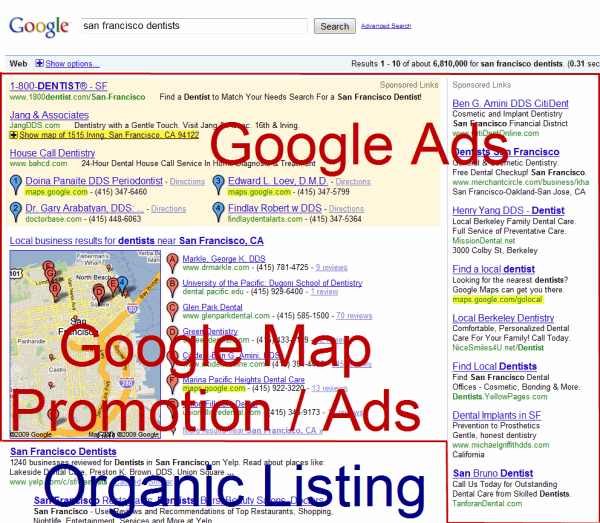
Noticing that trend, and seeing stuff like the below image, I thought it made sense to try to create something great servicing the AdWords / PPC market.

Google keeps controlling more real estate, and if you are not leveraging AdWords then there is a chance your business could eventually get pushed “below the fold” – perhaps not for longtail keywords…but certainly for the highest traffic and most valuable keywords in your industry. Google recently launched their vertical search panels, and to some degree you can think of many of these as what will eventually amount to some form of an ad channel (or a channel which promotes content from premium related partnerships with Google).

I am decent at AdWords, but my level of proficiency is nowhere near my level with SEO, and so we needed the help of someone else if we were going to make sure that we had bar-none the best product/service on the market. And so we decided to partner with Geordie to turn PPC Blog into a great membership website which mirrors this one.

Off the start access costs $179, but Geordie and I wanted to offer our blog readers a recurring 30% discount off of that, by using this code
EF0

This coupon will work for the first 100 subscribers, and then after the discount will no longer be available.

You can join here
http://ppcblog.com/member-tour-seobook/

Just like with SEO Book, you can cancel anytime and are under no obligation to stay any longer than you find it valuable to do so. If you do any serious amount of PPC it is quite easy to find a few tips that help you save $5 or more a day, especially when you consider how much PPC stuff Geordie has done (he has managed millions/yr in ad spend for the past 4 years & has brain dumped everything he knows) & how high quality the membership will be.

60+ training modules and a friendly PPC focused forum await you 😀